Syncubator Log in
IIT Mandi · Where care meets innovation

A smart, portable incubator for newborns.

Syncubator keeps a newborn warm, at the right humidity and oxygen level, on its own. It watches the baby's vital signs and weight, and raises an alarm the moment anything goes out of range. The same live view is on the incubator's own screen, a phone, and this website.

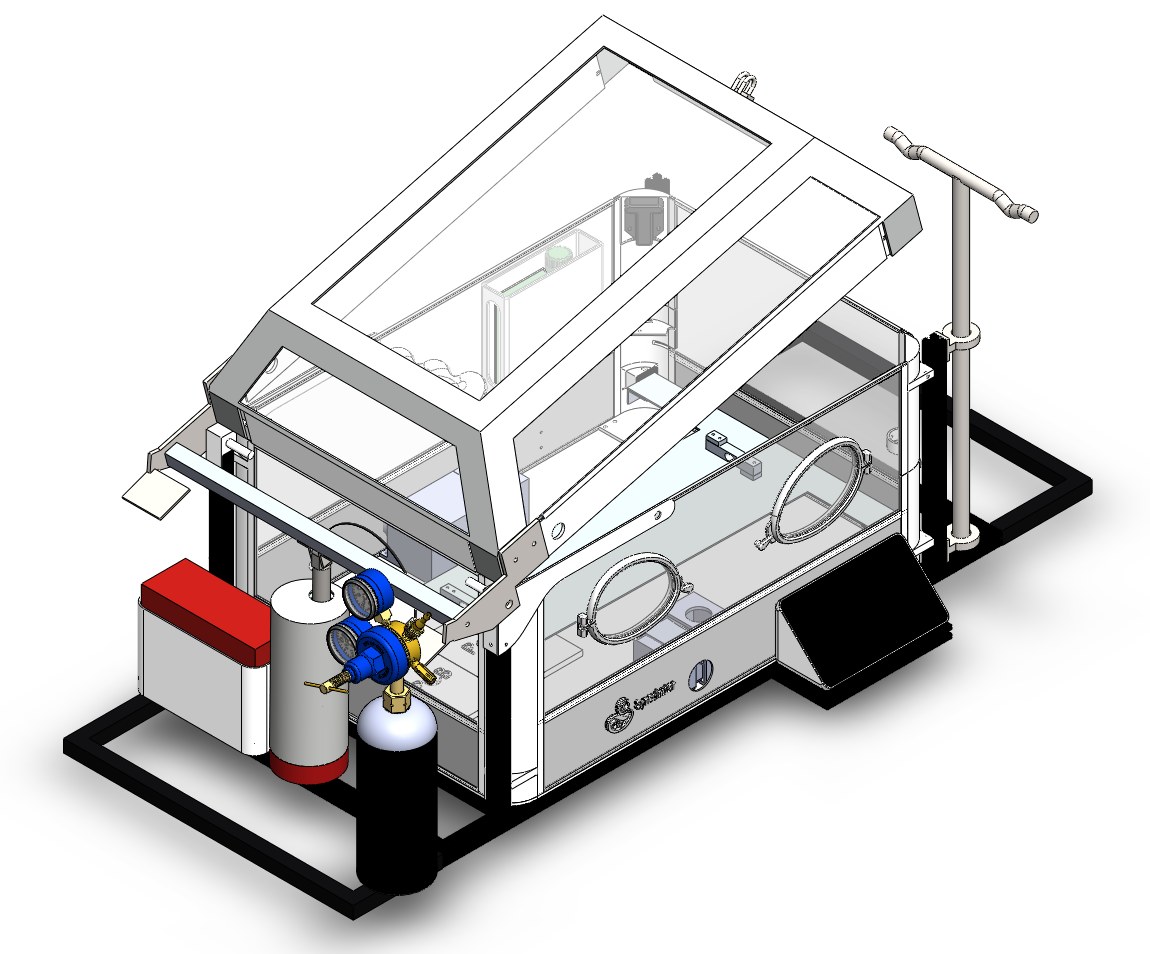
The Syncubator incubator with its motorised lid open: clear canopy, hand-access doors, touchscreen, battery and oxygen cylinder on a carry frame
Air temp36.5°C
Humidity55% RH
SpO₂97%
Weight2 310g
Example values, not live data
What it does

Everything a newborn needs around them, in one portable unit.

Warmth, air, monitoring and alarms work together, so staff can give their attention to the baby rather than to the machine.

Warmth and air

A steady, gentle environment

  • Temperature and humidityHolds the air at the temperature and humidity the clinician sets, all by itself. A second heater stands by as a backup.
  • OxygenMeasures the oxygen level inside and adds oxygen to keep it at the level that has been set.
  • Radiant warmerGentle warmth from above while the lid is open for care. It only works with the lid open, and switches itself off if the baby's skin gets too warm.
  • PhototherapyBlue light for treating newborn jaundice, switched on and off from the screen.
Watching the baby

Vital signs, always in view

  • Oxygen saturation and pulseSpO₂ and pulse rate from a sensor made for newborns, shown on every screen with their own alarms.
  • Skin temperatureA skin probe shows the baby's own temperature, with high and low alarms.
  • WeightThe bed weighs the baby where they lie, so there is no need to lift them out.
  • Live cameraWatch the baby from the bedside screen, a phone or this website.
Keeping watch

Alarms that never rely on a network

  • Alarms on the incubatorHigh, medium and low priority, each with its own sound and colour. The incubator checks and sounds them itself, so they work even if the Wi-Fi drops or a phone is off.
  • Limits set by the clinicianEvery reading has its own high and low limit. A short confirmation delay keeps a passing blip from sounding, and an alarm stays on screen until someone acknowledges it.
  • SOS buttonHold SOS for two seconds on any screen to call for help: a steady tone at the incubator and a red banner on every screen.
  • Smoke detectionSounds a high-priority alarm within a second, and switches the warmer off.
Made for the ward

Easy to work with, easy to move

  • Motorised lidOpens and closes at a touch. It will not close while the warmer is still hot.
  • Tilting bedThe mattress tilts up and down at a button, and only within its safe range.
  • One view on every screenThe bedside touchscreen, an Android app and this website show the same live readings and controls. Remote access needs an approved e-mail and a one-time code.
  • Remembers its settingsTargets and alarm limits survive a power cut and come back on their own.
  • PortableRuns on its own battery where mains power is unreliable, carries its own oxygen cylinder, and has carry handles at both ends.
A closer look

Control, alarms and one shared view.

What staff see and touch: the climate and oxygen cards, an alarm as it appears, and the controls that reach the incubator from wherever they are.

Climate & oxygen

Steady warmth, humidity and oxygen.

The clinician sets the air temperature, humidity and oxygen level, and the incubator keeps them there on its own: warming, humidifying and adding oxygen as needed, so the environment settles gently instead of swinging up and down.

  • Clinician-setTargets are chosen and changed from any screen.
  • Hands-offNo constant manual adjustment; control can be switched off at any time.
  • RemembersSettings and alarm limits are kept through a power cut and restored when power returns.
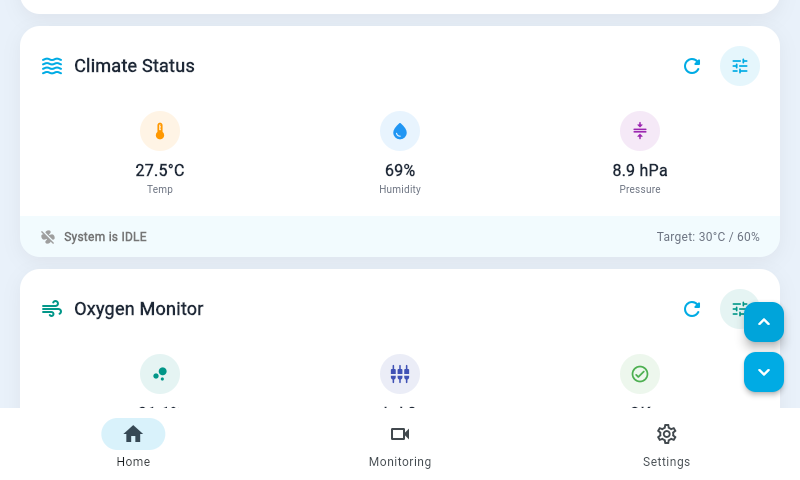
Climate and oxygen cards in the Syncubator application showing temperature, humidity, pressure and the oxygen valve level
Climate and oxygen cards as shown on the incubator's touchscreen.
Alarm system

Alarms that live on the incubator, not in the app.

Alarms are checked on the incubator itself and sound its own buzzer. If a browser closes, a phone sleeps or the Wi-Fi drops, the alarm still sounds. Every condition is watched continuously and follows medical alarm conventions rather than a plain threshold test.

  • 3 prioritiesHigh, medium and low, each with its own tone and banner colour.
  • 10 s onsetA breach must persist before it alarms, so a passing reading does not wake the ward.
  • LatchingAn alarm that clears on its own stays displayed until acknowledged. Silence lasts two minutes, then re-sounds.
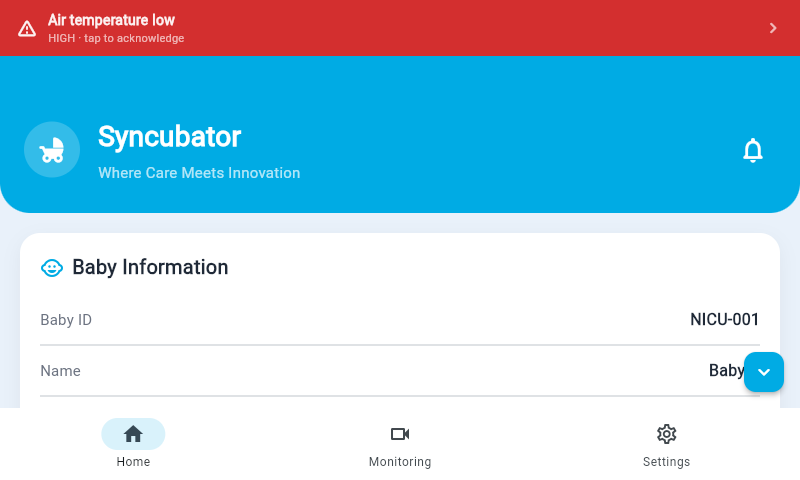
Syncubator application with a high-priority 'Air temperature low' alarm banner across the top
HIGHAir temperature lowlatched
MEDHeater on, temperature not risingrunaway check
LOWBed distance sensor not respondingsensor fault
Three of the alarm conditions, with their priorities.
Application

One application. The incubator's screen, a phone, this website.

The same application runs full-screen on the incubator's touchscreen, as an Android app, and here on the web behind a login. Every screen shows live readings, the camera and the same controls: targets, oxygen level, bed height, alarm acknowledgement and limits.

  • LiveEvery reading refreshes each second, over a secure connection.
  • LoginRemote access is restricted to approved e-mail addresses with a one-time code.
  • HonestIf a reading fails it is shown as a fault, never as a believable number.
Mattress height 11.6cm
Lowered · ready to raise
The mattress tilts up and down at the touch of a button, and only moves within its safe range. Try it.
Why build another incubator

The infants who need one most are often where one is hardest to afford.

Physiology

Preterm infants lose heat faster than they can make it.

A large surface area for their mass, little fat and an immature thermoregulatory response mean that in an ordinary room a preterm or low-birth-weight infant cools quickly, and hypothermia in the first hours of life is strongly associated with mortality.

Cost

Certified incubators do this well — at a price many district hospitals cannot meet.

A warmed, humidified, oxygen-enriched microenvironment held within limits, without continuous manual attention, is exactly what commercial incubators provide. Their cost keeps them out of the wards that need them.

Upkeep

Built to be looked after where it is used.

Syncubator is designed so that a hospital's own staff can understand, adjust and repair it, without waiting on a distant manufacturer for every fault.

Patents

A patented invention and a registered design.

The portable incubator is protected by an Indian patent granted to IIT Mandi, and its design is registered in India.

Indian patent · granted

A Portable Neo-Natal Incubator

Patent No. 566622
Application
202411010421
Filed
14 February 2024
Granted
23 May 2025, for 20 years from filing
Patentee
Indian Institute of Technology Mandi
Inventors
Keshav Verma, Gajendra Singh, Satvasheel Ramesh Powar, Vatsal Hariramani
Registered design

Incubator

Design No. 411961-001
Registered
29 March 2024
Class
24-01, under the Designs Act, 2000
Proprietors
Indian Institute of Technology Mandi, Gajendra Singh, Satvasheel Ramesh Powar, Keshav Verma, Dharkan Anand, Devesh Ojha, Divyank Sharma, Jyotishman Gogoi, Aman Sikarwar
Team

Built at IIT Mandi.

Syncubator is designed and built by a student team at the Indian Institute of Technology Mandi, Kamand, Himachal Pradesh, with faculty mentorship. It builds on the patented portable incubator above, adding the automatic controls, monitoring, alarms and the application described on this page.

Research prototype. Syncubator is an engineering project under development at IIT Mandi. It is not a certified medical device, has not been evaluated against IEC 60601 or any regulatory standard, and must not be used for the care of an infant.